

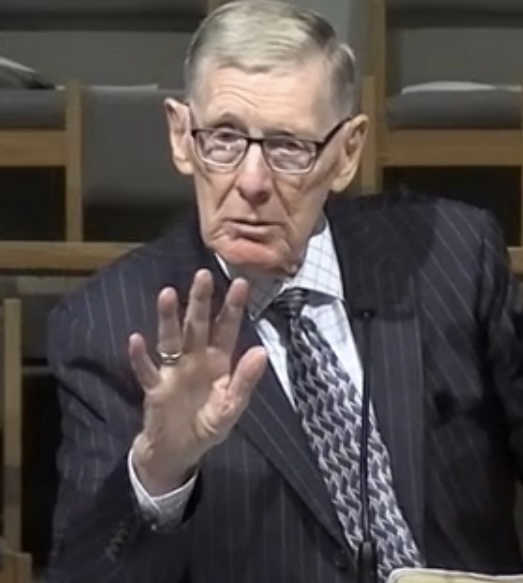
Pastor Jerry Rockwell
THE PROMISE OF GOD
Galatians 3:15-29
Introduction: Have you ever made a promise and then said, “Cross my heart, hope to die, stick a thousand needles in my eye.” This was a verification that you would never break your promise. Now we did that as children, and of course we did not know how to keep a promise. I have commented on how the people of Mexico respond to an invitation to come to church. They almost always say, “Sure, I will be there; you can count on me.” Then they never show up, and if you waited until they kept their promise, you might grow really old waiting. Even people of the U.S. are that way. I have even found that people in Florida are that way. I don’t know how many times I have been told that a person would be in church Sunday and that Sunday evidently has never arrived. I’m not always sure which Sunday they were talking about.
We can be thankful that God is not that way. When God makes a promise, He always keeps His word. 2 Corinthians 1:20: For all the promises of God in him are yea, and in him Amen, unto the glory of God by us. What is being said here is that ALL God’s promises are sure. They can be counted on. God does not go against His promise or His word. If God has given a promise, He always keeps it. Man is not that way. Man, sometimes, cannot be trusted.
This morning, I want to address the subject of the “Promise of God.” Note the word “Promise” is singular and not plural. We are dealing with one promise to Abraham (Gal. 3:7-9). This lesson is not about God’s promises. The first point concerns God’s promise to Abraham, and each subsequent point builds on it. For instance, God’s promise to Abraham is sure; even the Law cannot disannul it, and it leads to the provision in Christ. In fact, God’s promise to Abraham affects us: it provides that we can enter into that promise by faith and places us in Christ. This is a powerful subject and one we desperately need to grasp. The middle point could be titled “Why Go Back to Sinai?” That is where the Law was given, and many want to flee there; when they do, it nullifies faith. It is not the other way around because the Law cannot disannul the promise. We need to grasp what this passage is all about. When we learn this text and then apply it we will find ourselves set free from the law and on our way to a life of faith. That is the goal of this message. We need to be set free from the Law and live by faith. In some ways this message is a second part of last week’s sermon, Living by Faith. Let’s see what God has to say to us about this
matter of the promise.
As an illustration of where we are going to study the Old Testament, there is a movement in Atlanta, Georgia, that is influencing many Christians. That is the influence of a preacher named Andy Stanley. He is the son of Dr. Charles Stanley. He has been teaching for some time that we do not need the Old Testament. He calls it unnecessary for theology. I have referenced him before. This Bible lesson will demonstrate why the Old Testament is necessary for proper doctrine.
- THE PROMISE OF ABRAHAM, Galatians 3:15-18. Now Paul begins by saying something that many commentators stumble on. When he said, “I speak after the manner of men” he was not giving us his opinion. He is going to give us an illustration that will help us understand the working of God in the life of a believer. We cannot understand this section without looking again at Galatians 3:14: That the blessing of Abraham might come on the Gentiles through Jesus Christ; that we might receive the promise of the Spirit through faith. This section is about God’s promise to Abraham and how it affected us who came after Jesus Christ. Now we need to make note of the two elements in this verse. The first part is the promise of the “blessing of Abraham” that might come on the Gentiles. Then the second part “that we might receive the promise of the Spirit through faith.” This is about the promise to the spiritual descendants of Abraham, not the physical ones. Do not make the mistake of seeing this as a promise for the physical blessings of Abraham. We will see in Galatians 3:16 how this works in our lives today. Now we need to understand God’s promise to Abraham and how it works. These promises come in the form of a Covenant. We need to go back to Genesis to understand how this works. Note with me the promises God gave to Abraham.
- God’s Promise to Abraham and a Great Nation, Genesis 12:1-3. This promise to Abraham is that God would make him a “great nation” (vs. 2). He then adds that all the families of the earth will be blessed. This is a promise of a physical family which eventually became the Jewish nation. This was fulfilled when Jacob moved to Egypt, and God formed a great people who became a nation. The Jews are the only people that are a nation and a religion.
- God’s Covenant with Abraham, Genesis 15:1-21. This promise becomes the Covenant, and we need to note some important aspects about this Covenant.
- Abraham’s Problem with the Promise and Covenant. Abraham understood the promise in Genesis 12 and began to ask God about it because he was childless. God said in response to that inquiry, Genesis 15:4-5: 4 And, behold, the word of the Lord came unto him, saying, This shall not be thine heir; but he that shall come forth out of thine own bowels shall be thine heir. 5 And he brought him forth abroad, and said, Look now toward heaven, and tell the stars, if thou be able to number them: and he said unto him, So shall thy seed be. Here God reaffirms that Abraham will be a great nation and his descendants will be more numerous than the stars in the sky. Do not miss the fact that this is where Abraham “believed in the Lord; and he [God] counted it to him [Abraham] for righteousness” (Rom. 4:3; Gal. 3:6; James 2:23).
- Abraham’s Provision Emphasized by God. God then did something very unusual. He had Abraham take a three-year-old heifer and a three-year-old she-goat, a turtle dove, and a young pigeon (verse 9). Next, Abraham divided each into two pieces except the birds (verse 10). He then does something very interesting. Look at Genesis 15:12: And when the sun was going down, a deep sleep fell upon Abram; and, lo, an horror of great darkness fell upon him. During this time, God confirms to Abraham the way He will raise up Abraham’s seed. Look at Genesis 15:1-16. At this time, God does something very important while Abraham is in a “deep sleep.” God passes through the pieces that Abraham has placed in two parts. He did this by the “smoking furnace” (Genesis 15:17), which passed between the pieces. This was God’s way of telling Abraham that He was committing Himself to the fulfillment of the promise. This is called in theological terminology an “Unconditional Covenant.” This means that Abraham did nothing to fulfill this covenant, but God was responsible for carrying it out. God obligates himself to the completion of the promise. Afterward, God promises Abraham the land in Genesis 15:18-21. The Jews were given the land promise and we need to remember that the church has never been given a land promise in which we will occupy. Our promise is that of heaven.
- God’s Sign of the Covenant, Genesis 17:1-27. We will not explore this promise, but it too is connected to the promise of a seed. Abraham is now 90 years old (Genesis 17:1). He still has no children. Look at Genesis 17:7-8: 7 And I will establish my covenant between me and thee and thy seed after thee in their generations for an everlasting covenant, to be a God unto thee, and to thy seed after thee. 8 And I will give unto thee, and to thy seed after thee, the land wherein thou art a stranger, all the land of Canaan, for an everlasting possession; and I will be their God. God confirms the promise of the seed and the land. He then gives a sign of this covenant: the sign of circumcision (Genesis 17:10-14). The next thing God does is promise to Abraham and Sarah that they will have a child in Genesis 17:19, And God said, Sarah thy wife shall bear thee a son indeed; and thou shalt call his name Isaac: and I will establish my covenant with him for an everlasting covenant, and with his seed after him.
- God’s Promise, Genesis 17:1-33. This is the well-known passage in which God and two men (who are actually angels, according to Genesis 19:1) come to Abraham and again confirm the promise of seed to the two of them. The mission of the three was because of the wickedness of Sodom. Yet in the midst of this interchange of what God is doing he says to Abraham and Sarah in Genesis 18:18-19 18 Seeing that Abraham shall surely become a great and mighty nation, and all the nations of the earth shall be blessed in him? 19 For I know him, that he will command his children and his household after him, and they shall keep the way of the Lord, to do justice and judgment; that the Lord may bring upon Abraham that which he hath spoken of him. This is the promise of the “spiritual blessing” through Abraham. The nomenclature changes from families in Genesis 12:3: And I will bless them that bless thee, and curse him that curseth thee: and in thee shall all families of the earth be blessed, which is a promise of the physical descendant of Abraham. When you come to Genesis 18:18, Seeing that Abraham shall surely become a great and mighty nation, and all the nations of the earth shall be blessed in him? The terminology turns to nations (plural), which now includes you and me. We are part of the nations. That brings us full circle to Galatians 3. Now note with me Galatians 3:15: Brethren, I speak after the manner of men; Though it be but a man’s covenant, yet if it be confirmed, no man disannulleth, or addeth thereto. Paul is not saying this was a covenant made by man, but that it was a covenant God made with man. This made it a “man’s” covenant. Note the statement, “…yet if it be confirmed, no man disannulleth it, or addeth thereto” (verse 15). In other words, man cannot affect the results of this covenant other than be a recipient of the blessings connected with the covenant. This brings us to the major statement of this passage. Galatians 3:16: Now to Abraham and his seed were the promises made. He saith not, And to seeds, as of many; but as of one, And to thy seed, which is Christ. The application Paul gives here identifies the “seed” as singular and being Christ. The point must not be overlooked. The promise of Abraham comes THROUGH JESUS CHRIST, who is the seed of Abraham. Look at Matthew 1:1: The book of the generation of Jesus Christ, the son of David, the son of Abraham. What Paul is saying is that we have the promise of Abraham by faith. Just as Abraham “believed the Lord” we must do the same thing. This will become evident in a moment. Now do not miss the transition in Galatians 3:17: And this I say, that the covenant, that was confirmed before of God in Christ, the law, which was four hundred and thirty years after, cannot disannul, that it should make the promise of none effect. Abraham believed God, and that came 430 years before the Law (Gal. 3:17). The law cannot make the promise of no effect. The law cannot stop the promise. Remember that Abraham was promised an inheritance. He received this before the law. If the law confirmed the promise, it no longer becomes a promise. God gave the inheritance to Abraham by promise. This leads us to the next point.
- THE PURPOSE OF THE LAW, Galatians 3:19-22. If the law cannot add to an inheritance and provide a promise, then why do we need the law? That is a good question. You see, man likes to appeal to the flesh and demonstrate that they can obey laws and keep the “holy days” and even fast. Man likes to be religious. The flesh likes to show how “religious” a man is. Remember the Pharisee and the Publican who went to the Temple to pray in Luke 18:9-14? The Pharisee boasted how religious he was by not being like the Publican. Why did the Pharisee emphasize how he fasted two times a week and gave tithes of all he had? He boasted that he was not as other men, extortioners, unjust, and adulterers, as even the Publican was. This is the man who likes to tell how “spiritual” he is. Why I witness all the time, and I pray all the time, and I even read my Bible. Surely God is impressed with me. This is missing the point. The law was not given to enable us to show how adept we are at keeping the law. Look at Galatians 3:19, Wherefore then serveth the law? It was added because of transgressions… Look at Galatians 3:24 Wherefore the law was our schoolmaster to bring us unto Christ, that we might be justified by faith. The law was given to demonstrate how sinful we really are. Look at Romans 7:7-9: 7 What shall we say then? Is the law sin? God forbid. Nay, I had not known sin, but by the law: for I had not known lust, except the law had said, Thou shalt not covet. 8 But sin, taking occasion by the commandment, wrought in me all manner of concupiscence. For without the law sin was dead. 9 For I was alive without the law once: but when the commandment came, sin revived, and I died. The law was given that we might understand that we are sinners and cannot keep the commandments. We need someone to step in and annul the law that we might be set free from the condemnation of the law. Thus, the importance of Galatians 3:19-20: 19 Wherefore then serveth the law? It was added because of transgressions, till the seed should come to whom the promise was made; and it was ordained by angels in the hand of a mediator. 20 Now a mediator is not a mediator of one, but God is one. Now understand what is being said here. When God dealt with Abraham, he did so directly. There was no mediator. When the law came, Moses was the mediator, and God did not deal with Israel directly. That is why there was a High Priest to be a mediator between God and Israel. We are “in Christ” and therefore do not need a mediator because God deals with us directly as He did with Abraham. (Ephesians 2:6: And hath raised us up together, and made us sit together in heavenly places in Christ Jesus; Colossians 1:27: To whom God would make known what is the riches of the glory of this mystery among the Gentiles; which is Christ in you, the hope of glory.) The law was “ordained by angels” (Gal. 3:19), indicating that God was going through a mediator. Still, the law cannot do away with the promise. Why would one return to Sinai? You see the whole problem with the Roman Catholic Church is that it has instituted the law because the priest is a mediator. If you are in Christ, you do not need a mediator; Christ is your mediator (Rom. 8:34; Heb. 7:25). Now do not miss Galatians 3:22: But the scripture hath concluded all under sin, that the promise by faith of Jesus Christ might be given to them that believe. When we believe, then we live by faith and are no longer under the law. The law was given to bring us to Christ. That is the message in the next point.
- THE PROVISION IN CHRIST, Galatians 3:23-29. When a person refuses to believe, they live under the condemnation of the law. When a person accepts Christ, then they are set free from the law and are JUSTIFIED BY FAITH. When faith enters in, then we are no longer under the schoolmaster, the law; we are children of God by our faith in Jesus Christ. Look at Galatians 3:25-26: 25 But after that faith is come, we are no longer under a schoolmaster. 26 For ye are all the children of God by faith in Christ Jesus. We cannot overlook even Galatians 3:27: For as many of you as have been baptized into Christ have put on Christ. This should remind us of 1 Corinthians 12:13: For by one Spirit are we all baptized into one body, whether we be Jews or Gentiles, whether we be bond or free; and have been all made to drink into one Spirit; Ephesians 4:4, There is one body, and one Spirit, even as ye are called in one hope of your calling. We need to understand that Paul is speaking about spiritual things, not physical things. When a person makes these matters physical, then they make water baptism the vehicle in which a person is placed in Christ. That is the heresy of the Church of Christ and the Roman Catholic Church and any other group that teaches baptismal regeneration. Water baptism does not join you to Christ; it joins you with the water. When we are joined with Christ, made in union with Christ, we are no longer anything but “ONE IN CHRIST JESUS” (Galatians 3:28). We become “heirs according to the promise” (Galatians 3:29) and nothing less. When a person exercises faith in Jesus Christ, they are placed in Christ, have a relationship with God by faith, and no longer need a mediator. If we are under the promise, then God accepts us as He accepts Christ since we are IN HIM!
Conclusion: We are now children of the promise. Paul stated his apostleship and its application in 2 Timothy 1:1: Paul, an apostle of Jesus Christ by the will of God, according to the promise of life which is in Christ Jesus. Paul lived according to the promise of life in Christ Jesus. Let’s read Ephesians 2:11-19. This is our spiritual constitution. We live under this statement of peace.